
Mastering Data Structures and Algorithms: A Practical Guide for Problem Solving and Real-World Applications
From Sorting to Shortest Paths – Learn the Core DSA Concepts That Power Today’s Software Systems

In today’s fast-paced tech landscape, mastering Data Structures and Algorithms (DSA) is more than just preparation for coding interviews — it’s the cornerstone of building efficient, reliable, and scalable software systems. From AI models to enterprise-grade applications, DSA concepts influence the performance and architecture of every solution. This article explores key data structures and algorithms not through code, but through detailed explanations, types, and relatable real-world examples, helping learners grasp where and how each concept is applied in practical scenarios.
1. Sorting Algorithms
Definition: Sorting is the process of arranging elements in a specific order, usually ascending or descending.
Types of Sorting:
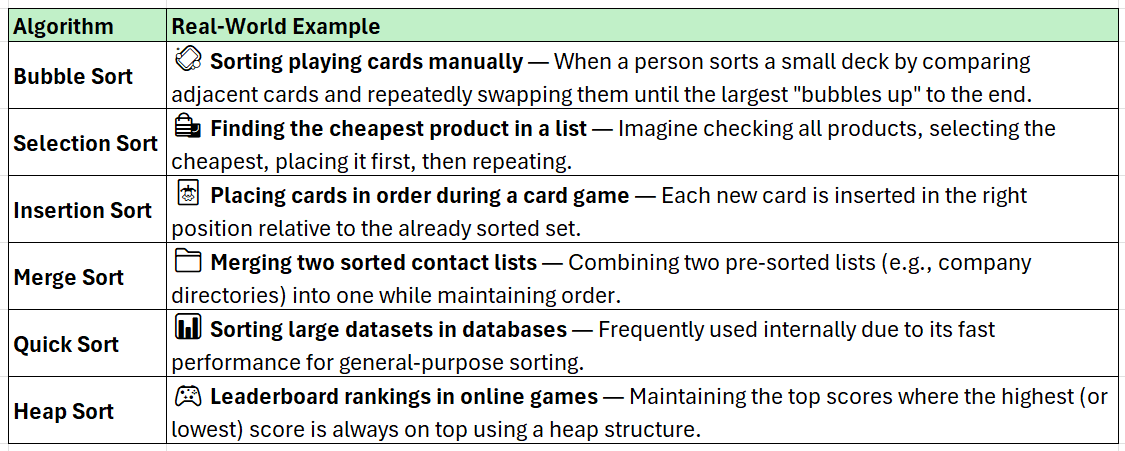
Bubble Sort: Repeatedly swaps adjacent elements if they are in the wrong order.
Selection Sort: Selects the smallest element from the unsorted part and swaps it with the first unsorted element.
Insertion Sort: Builds the sorted array one element at a time by inserting in the right place.
Merge Sort: A divide-and-conquer algorithm that splits arrays and merges them in order.
Quick Sort: Partitions the array into smaller parts based on a pivot and sorts recursively.
Heap Sort: Uses a binary heap data structure for sorting.
Use Cases:
Sorting product prices in an e-commerce platform
Ranking leaderboards or exam scores
Organizing files, logs, or emails by timestamp
Live Example:
Amazon Product Listing – When you sort products by "Price: Low to High" or "Customer Rating," sorting algorithms like Merge Sort or Quick Sort are used behind the scenes to rearrange items efficiently.
Examples
2. Linked Lists
Definition: A linear data structure where each element (node) contains data and a reference (pointer) to the next node.
Types:
Singly Linked List: Each node points to the next node.
Doubly Linked List: Nodes have pointers to both the next and previous nodes.
Circular Linked List: The last node points back to the first node.
Use Cases:
Implementing undo/redo operations in editors
Managing dynamic memory where size isn't predetermined
Browser history navigation
Live Example:
Microsoft Word – Undo/Redo Feature – Every action you perform is stored in a linked structure so that you can undo or redo actions in sequence. This is efficiently managed using a Doubly Linked List.
Examples

3. Stacks and Queues
Stack
Definition: A Last-In-First-Out (LIFO) data structure where the last element added is the first to be removed.
Use Cases:
Expression parsing and evaluation
Backtracking algorithms (e.g., solving mazes or puzzles)
Reversing strings or function call stacks
Live Example:
Web Browser – Back Button – Every visited webpage is pushed onto a stack. When you click "Back," the browser pops the last page visited and returns to the previous one.
Examples:

Queue
Definition: A First-In-First-Out (FIFO) data structure where the first element added is the first to be removed.
Types:
Simple Queue
Circular Queue
Priority Queue
Double-Ended Queue (Deque)
Use Cases:
Task scheduling in operating systems
Customer service ticket management
Network packet management
Live Example:
Customer Support Call System – Calls are answered in the order they arrive. A queue ensures the "first come, first served" model.
Examples

4. Hash Tables
Definition: A data structure that stores key-value pairs and uses a hash function to compute the index for each key.
Equivalent in Python: Dictionary
Use Cases:
Implementing lookup tables, caching, and dictionaries
Counting occurrences of items (frequency maps)
Fast access to data in constant time (average case)
Real-World Example: Autocomplete features in search engines or mobile keyboards
Live Example:
Login Authentication System – When you enter your username and password, the system uses a hash table to quickly check credentials and fetch user data in constant time.
Examples:

5. Trees
Definition: A hierarchical data structure with a root node and children forming a tree-like structure.
Types:
Binary Tree: Each node has at most two children.
Binary Search Tree (BST): Left child has smaller values; right child has larger values.
AVL Tree / Red-Black Tree: Self-balancing BSTs for optimized performance.
Heap (Min-Heap / Max-Heap): Special tree used in priority queues.
Trie: Efficient tree structure used to store a dynamic set of strings.
Use Cases:
Storing hierarchical data (organization charts, file systems)
Autocomplete in search engines using Tries
Prioritizing tasks in job scheduling (using Heaps)
Implementing memory-efficient search trees in compilers
Live Example:
Operating System File Explorer (Windows/macOS) – The folder-directory structure is a classic tree, where each folder can contain subfolders or files in a hierarchical format.
Examples:

6. Graphs
Definition: A non-linear data structure consisting of nodes (vertices) connected by edges.
Types:
Directed vs Undirected
Weighted vs Unweighted
Cyclic vs Acyclic
Representations:
Adjacency List: More memory-efficient for sparse graphs.
Adjacency Matrix: Easier to implement for dense graphs.
Use Cases:
Social networks (users and connections)
Routing in GPS and map applications
Webpage link structures (PageRank algorithm)
Modeling relationships in recommendation systems
Live Example:
Google Maps Navigation – Locations are nodes, roads are edges. Graphs are used to represent and explore all possible routes between points.
Examples:

7. Shortest Path Algorithms
Definition: Algorithms that find the minimum cost path between two nodes in a graph.
Popular Algorithms:
Dijkstra’s Algorithm: Finds the shortest path in weighted graphs with non-negative edges.
Bellman-Ford Algorithm: Handles graphs with negative weights.
A* Algorithm: Heuristic-based shortest path search, ideal for AI-based pathfinding.
Use Cases:
Google Maps and GPS routing
Network routing protocols (e.g., OSPF)
AI game agents finding optimal moves
Live Example:
Uber or Ola Ride Optimization – To find the quickest route from your location to the destination, Uber uses Dijkstra’s Algorithm or A* to calculate the shortest distance in real-time.
Example:

8. Minimum Spanning Tree (MST)
Definition: A subset of edges that connects all the vertices in a graph with the minimum total edge weight and no cycles.
Popular Algorithms:
Prim’s Algorithm
Kruskal’s Algorithm
Use Cases:
Designing cost-effective communication or road networks
Reducing the cost of power or water supply networks
Clustering in unsupervised machine learning
Live Example:
Laying Fiber Optic Cables for Internet Networks – Telecom companies use MST to connect cities with minimum cable length and cost while ensuring every city is reachable without redundancy.
Example:

9. Maximum Flow Problem
Definition: Determines the maximum possible flow of a resource from a source to a sink in a network.
Popular Algorithm: Ford-Fulkerson
Use Cases:
Allocating bandwidth in network traffic
Job assignment and resource optimization
Modeling water distribution in pipes or electric flow in circuits
Live Example:
Amazon Warehouse – Order Packing Optimization – Each packing station has a limit. Algorithms like Ford-Fulkerson are used to determine how to route the maximum number of packages from suppliers to delivery lines without bottlenecks.
Example:

10. Time and Space Complexity
Definition:
Time Complexity measures how the runtime of an algorithm grows with input size.
Space Complexity measures how memory usage grows with input size.
Big-O Notation Overview:
O(1): Constant time
O(log n): Logarithmic time (e.g., binary search)
O(n): Linear time
O(n log n): Merge sort, efficient algorithms
O(n²), O(2ⁿ): Less efficient, brute-force methods
Use Case:
Used in choosing the most efficient algorithm or data structure to meet performance requirements under constraints.
Live Example:
WhatsApp Message Delivery – When millions of users send messages, efficient algorithms with optimal time and space complexity are crucial for real-time message processing with minimal delay and memory use.
Examples:

Conclusion
Understanding Data Structures and Algorithms is like learning the grammar of programming — it shapes how problems are approached, structured, and solved. While modern libraries and frameworks often abstract the complexity, your ability to make sound design and performance decisions depends on grasping the underlying concepts.
This article intentionally focused on real-world examples and practical use cases, rather than code, to help you internalize where and how each data structure and algorithm applies in real-life scenarios. Whether you're a student preparing for interviews, a professional refining your skills, or an engineer building scalable systems, a strong conceptual foundation in DSA empowers you to write better software and architect smarter solutions.
For more in-depth technical insights and articles, feel free to explore:
Girish Central
LinkTree: GirishHub – A single hub for all my content, resources, and online presence.
LinkedIn: Girish LinkedIn – Connect with me for professional insights, updates, and networking.
Ebasiq
Substack: ebasiq by Girish – In-depth articles on AI, Python, and technology trends.
Technical Blog: Ebasiq Blog – Dive into technical guides and coding tutorials.
GitHub Code Repository: Girish GitHub Repos – Access practical Python, AI/ML, Full Stack and coding examples.
YouTube Channel: Ebasiq YouTube Channel – Watch tutorials and tech videos to enhance your skills.
Instagram: Ebasiq Instagram – Follow for quick tips, updates, and engaging tech content.
GirishBlogBox
Substack: Girish BlogBlox – Thought-provoking articles and personal reflections.
Personal Blog: Girish - BlogBox – A mix of personal stories, experiences, and insights.
Ganitham Guru
Substack: Ganitham Guru – Explore the beauty of Vedic mathematics, Ancient Mathematics, Modern Mathematics and beyond.
Mathematics Blog: Ganitham Guru – Simplified mathematics concepts and tips for learners.