
Classical Computing vs Quantum Computing: A Detailed Comparison
Exploring the Fundamental Differences, Hardware Requirements, Programming Languages, and Computational Power Features

Classical Computing
Classical computing is based on conventional computers that use bits as the fundamental unit of data. These computers operate on binary logic, where a bit can be in one of two possible states: 0 or 1.
1. Bits and Logic Operations
A bit is the most basic unit of information. It can represent two states:
0: The light is OFF.
1: The light is ON.
A classical computer uses logic gates to manipulate these bits. Logic gates like AND, OR, and NOT combine bits and perform operations based on specific rules.
For example:
AND Gate: Both inputs must be 1 for the output to be 1.
If A = 1 and B = 0, the output is 0. If A = 1 and B = 1, the output is 1.OR Gate: If either of the inputs is 1, the output will be 1.
NOT Gate: It reverses the value of the input. If input = 1, the output = 0.
These gates form the building blocks of all operations in classical computing.
2. Sequential Processing and Algorithms
Classical computers process tasks sequentially. This means that they work on one operation at a time. For example, if you have a list of numbers and need to find the largest number, a classical computer will go through each number one by one and compare them.
Example of Sequential Processing: Imagine you are trying to find the largest number in this list: [5, 2, 9, 1, 3]. A classical computer will:
Compare 5 with 2 → Largest = 5.
Compare 5 with 9 → Largest = 9.
Compare 9 with 1 → Largest = 9.
Compare 9 with 3 → Largest = 9. After comparing all the numbers, the largest number (9) is found.
3. Classical Algorithms:
In classical computing, algorithms like sorting, searching, and graph traversal are fundamental and follow specific steps to find a solution. For example, the Merge Sort algorithm divides the list into smaller pieces, sorts them, and then merges them back together.
Quantum Computing
Quantum computing uses quantum bits (qubits), which can exist in multiple states at once. Quantum computing introduces new capabilities and challenges compared to classical computing.
1. Qubits and Quantum States
A qubit is the fundamental unit of data in quantum computing. Unlike classical bits, qubits are not just 0 or 1. Due to superposition, a qubit can be in a state that is 0, 1, or any combination of these, simultaneously.
Superposition:
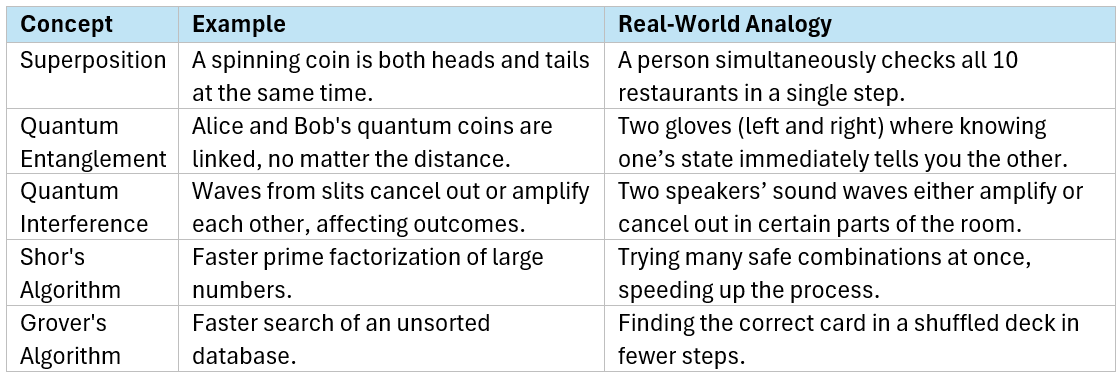
Superposition means that a qubit can exist in multiple states at once. This is similar to a spinning coin: while the coin is spinning, it is both heads and tails at the same time. It is only when we measure the qubit that it "chooses" a state (0 or 1).
Example of Superposition: Think of a light switch that can be both on and off at the same time, instead of just being either on or off like in classical computing. So if you had multiple lights, they could all be in multiple states simultaneously.
2. Quantum Entanglement
Another key property is entanglement. When qubits become entangled, their states become linked, so the state of one qubit affects the state of the other, even if they are physically separated. This phenomenon enables quantum computers to process complex tasks more efficiently than classical computers.
Example of Entanglement:
Imagine you have two friends who agree that if one raises their hand, the other will immediately do the opposite. Even if they are far apart (one on one side of the world, the other on the other), when one friend raises their hand, the other instantly knows to lower theirs. This is like entanglement in quantum computers.
3. Quantum Interference
Consider the double-slit experiment in quantum mechanics. A single particle (like an electron) can pass through two slits and interfere with itself, creating a wave-like interference pattern on the screen behind the slits.
This interference can either amplify (make certain paths more likely) or cancel out (eliminate certain paths) based on how the waves interact. In quantum computing, quantum algorithms use this property to enhance the probability of correct answers and cancel out wrong ones.
Real-World Analogy: Imagine you have two speakers playing the same song but out of sync with each other. In some parts of the room, the sound waves from the speakers will amplify each other, making the music louder (constructive interference). In other parts, the waves will cancel each other out, creating silence (destructive interference). Quantum computers use similar interference to narrow down to the correct solution.
4. Quantum Algorithms
Quantum computers use algorithms that take advantage of superposition, entanglement, and interference. Some famous quantum algorithms are:
Shor’s Algorithm: Used for factoring large numbers efficiently, which is exponentially faster than classical algorithms. This can potentially break current encryption methods.
Example: Shor’s algorithm is a quantum algorithm designed to factor large numbers quickly. Let’s say you want to factor the number 15 into prime numbers. The classical way would involve checking divisibility by numbers like 2, 3, 4, etc., until you find the prime factors (3 and 5). For large numbers, this process is time-consuming for classical computers. However, Shor’s algorithm can find the factors much faster by using quantum parallelism and periodicity to calculate the factors exponentially quicker.
Real-World Analogy: Imagine trying to find the combination to a locked safe. A classical approach would involve trying each combination one by one. Shor’s algorithm allows you to try many combinations simultaneously, dramatically speeding up the process.
Grover’s Algorithm: Used to search unsorted databases faster than classical algorithms.
Example: Grover's algorithm is used to search an unsorted database. Let's say you have a list of 1000 names, and you need to find the name "Girish".
A classical search would involve checking each name, one by one, which would take, on average, about 500 checks (half of the list).
Grover’s algorithm, however, can search the entire list in approximately √1000 = 31 steps, making it exponentially faster.
Real-World Analogy: Think of a game where you are trying to find a specific card from a shuffled deck of cards. A classical method would involve looking at each card one by one. With Grover’s algorithm, you could "amplify" the correct card’s position, allowing you to find it in far fewer steps.
Summary of Examples
Key Differences Between Classical and Quantum Computing
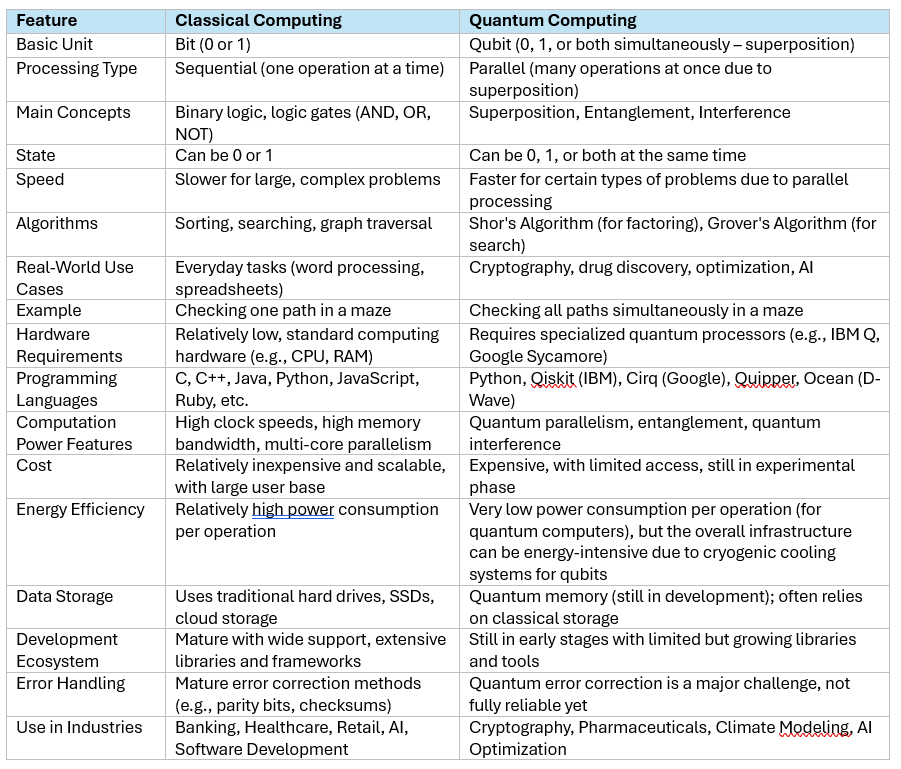
1. Computational Model
Classical Computing: Uses bits (0 or 1) to represent and manipulate data. It follows deterministic logic and sequential processing.
Quantum Computing: Uses qubits that can represent 0, 1, or both at once (superposition). Quantum computing relies on probabilistic outcomes and can process information in parallel.
2. Superposition
Classical Computing: Each bit is either 0 or 1.
Quantum Computing: Each qubit can be 0 and 1 simultaneously (superposition), allowing quantum computers to process many possibilities at the same time.
3. Entanglement
Classical Computing: No such phenomenon.
Quantum Computing: Qubits can be entangled, meaning the state of one qubit can affect the state of another, no matter the distance between them.
4. Speed and Efficiency
Classical Computing: Processes information sequentially, which can be slower, especially for large, complex problems.
Quantum Computing: Can process vast amounts of data simultaneously due to superposition and entanglement, which makes it faster for certain types of problems.
5. Real-World Applications
Classical Computing: Suitable for tasks like word processing, browsing the web, running spreadsheets, and basic data analysis.
Quantum Computing: Suitable for solving specific problems that are too complex for classical computers, such as encryption, drug discovery, material science, optimization, and AI.
Summary of Classical vs. Quantum Computing
For more in-depth technical insights and articles, feel free to explore:
Girish Central
LinkTree: GirishHub – A single hub for all my content, resources, and online presence.
LinkedIn: Girish LinkedIn – Connect with me for professional insights, updates, and networking.
Ebasiq
Substack: ebasiq by Girish – In-depth articles on AI, Python, and technology trends.
Technical Blog: Ebasiq Blog – Dive into technical guides and coding tutorials.
GitHub Code Repository: Girish GitHub Repos – Access practical Python, AI/ML, Full Stack and coding examples.
YouTube Channel: Ebasiq YouTube Channel – Watch tutorials and tech videos to enhance your skills.
Instagram: Ebasiq Instagram – Follow for quick tips, updates, and engaging tech content.
GirishBlogBox
Substack: Girish BlogBlox – Thought-provoking articles and personal reflections.
Personal Blog: Girish - BlogBox – A mix of personal stories, experiences, and insights.
Ganitham Guru
Substack: Ganitham Guru – Explore the beauty of Vedic mathematics, Ancient Mathematics, Modern Mathematics and beyond.
Mathematics Blog: Ganitham Guru – Simplified mathematics concepts and tips for learners.